


By Iqra Nayab
In Sujawal, a small town in Sindh about ten kilometres from the Indus River, Muneer Ahmed teaches art to children with disabilities and paints the rhythms of village life in the hours after. He has never set foot inside an art school. No mentor guided his hand and yet, for over four years, he has held the title of art teacher at a special education institute in his hometown, a role he insists on calling, deliberately, “special art educator.”
“People ask how I can teach something I was never formally taught,” he says, “But learning doesn’t only happen in institutes. A person keeps learning from whatever life gives them.” What life gave Muneer was a childhood without the internet, a fascination with the illustrations in the magazines he read as a boy, which he copied obsessively from as early as first grade and, later, trips to Karachi to buy art books and basic supplies before the internet made that hunting unnecessary. He calls himself self-taught not as a disclaimer but as a fact of survival. He built his own foundation, brick by brick, because there was no one else to build it for him.

Colour, light and shadow, the elements that take other painters years of guided practice to master, came to him early and instinctively. He attributes this simply to a gift from God.
Ask Muneer whether one particular painting made him realise art was his calling and he’ll tell you the question doesn’t quite apply to him. Growing up in a village, he didn’t know art could be a career, let alone that paintings could be sold. He painted because it was his “shauq,” a passion with no exit ramp. “I can’t imagine not doing this,” he says. “There was never a moment I wanted to leave it.”

Still, one work changed his direction. In 2016, he painted a scene he’d witnessed near a rice field, a woman and her child planting the crop, ankle deep in water. It became his first painting in an impressionist style and something about it moved him so deeply that he decided, then and there, this would be his language going forward. Before that, his landscapes had been just landscapes, figures were an afterthought. Afterward, he understood that a human figure gives a landscape its soul.
That instinct, figure as soul, runs through everything Muneer paints now. They aren’t generic pastoral scenes but in his words, he’s attempting to capture not just a place but a “time of day,” the particular gold of late afternoon, the hush of early morning because each hour carries its own emotional register.

“Scenery painters just paint beauty,” he explains. “I try to paint the beauty that belongs to a specific moment I actually felt.” He gives equal weight to figure and surrounding, refusing the common technique of foregrounding a subject at the expense of the world around them. For Muneer, the water’s blue and the grass’s green are as essential to the story as the girl standing between them.
Muneer doesn’t romanticise how he got here. Rural Sindh, he says plainly, barely recognises art as a discipline worth taking seriously. Commercial work, signboards, that sort of thing, is often mistaken for the whole of what “art” means. Formal art education is functionally absent in the villages. The National College of Arts (NCA) and the art universities of Hyderabad and Karachi, existed for him only as names in library books, out of reach without family support or financial backing.

“People say artists from the villages get lucky, that they stumble into opportunity,” he says. “I don’t see it that way. You have to build your own luck, through obsession and whatever guidance and support you can find.” His own path, he’s candid, was built almost entirely alone. He points out that Sindh’s larger cities, such as Karachi and Hyderabad, at least have artists and access to art education. In the villages, there’s none of that, which is a big part of why so few rural artists manage to advance.
One of Muneer’s most affecting paintings shows a girl standing in a rain soaked field, her reflection rippling beneath her. He remembers the moment precisely. An Eid afternoon, two or three years ago, riding his motorbike down a narrow lane while other children played in their Eid clothes. This girl was walking back from the flooded field, unconcerned with her clothes, unconcerned with the day’s supposed significance. “For poor families, every day is an ordinary day,” he says. Her red clothes stood in complementary contrast against the surrounding greenery and the mud brick homes, her reflection broke gently as she walked. The water itself was leftover rainwater pooled in the field. It’s a small, unremarkable scene by most measures and exactly the kind of moment Muneer says he’s built his entire practice around noticing.

Another painting in his catalogue, Innocence at Noon, shows children catching small fish and playing in a stream, shaded by trees, mud houses behind them. He didn’t compose this scene, he simply watched it happen and recognised his own childhood inside it. He, too, played in that river once, under that same tree shade. “It’s not really a deliberate theme,” he says of his fixation on rural life. “These are my own inspirations. The beauty isn’t just in the figures it’s in the figures together with the landscape.”
Muneer paints without a team, without an editor and mostly without a camera rolling. Fans ask him to document his painting process for social media. “Filming while I paint is genuinely difficult,” he admits. “The feeling of the painting disappears, the flow breaks. My mind needs to be entirely on the canvas, the video is secondary.” He recognises social media’s importance in the current age but for him, finishing the work with total presence takes precedence over documenting it.
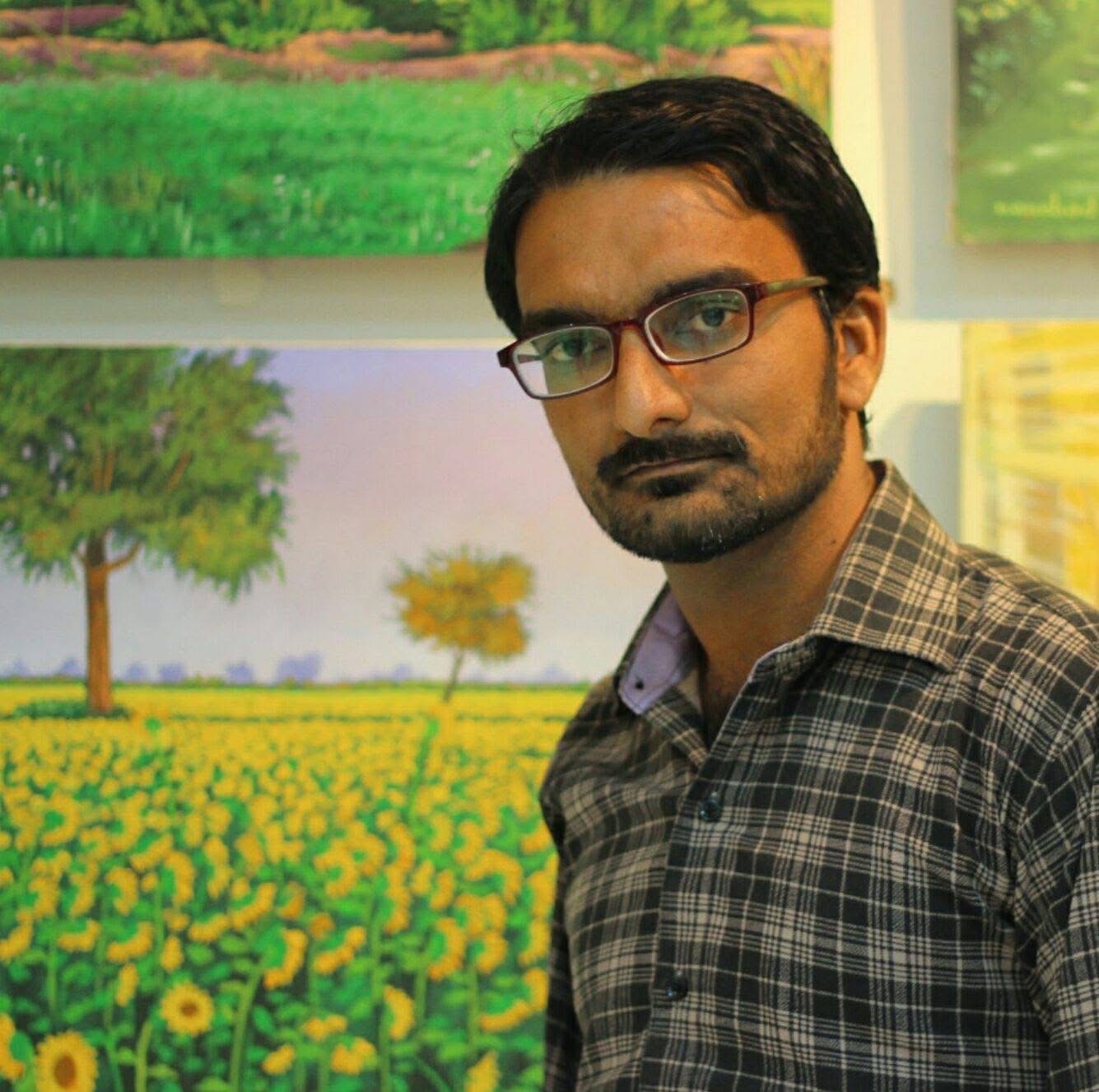
The same logic shapes where he paints. He almost never works on location, not from lack of desire but from lack of equipment and a second pair of hands to help transport an easel and supplies. Instead, he observes a place in person, then returns to his home studio to paint entirely from memory and reference. It helps that he doesn’t have to travel far for inspiration as the village begins right behind his house in the small town where he lives.
Muneer works exclusively in oils, despite having experimented with watercolour and acrylic because oil lets him build texture and translate feeling most directly. His style has been impressionist from the start, bold strokes, saturated colour, and above all, light. “If a painter can’t render light,” he says, “they haven’t yet learned what it means to paint a landscape.” He resists the idea that he moves between two modes, precise figuration and loose impressionism, insisting instead that the figure and the landscape tell one continuous story, the figure doubles the feeling that’s already present in the light and the time of day.
Sindh’s recent catastrophic floods hit Muneer’s own hometown directly, though not for the first time. In 2010, when floodwaters closed in, he evacuated with his family to Karachi for safety. What he returned to was devastation, mud houses destroyed, fields ruined, a town gone still and yet, he remembers something else too. Fishing with friends in the very floodwater that had wrecked their homes, finding small pockets of enjoyment amid the wreckage because, as he puts it, “an artist finds beauty everywhere.”

His hometown has weathered disasters before and each time, life has returned, fields green again, flowers blooming again. “Natural disasters can’t destroy the beauty of a place…it’s always still there, waiting to be found.”
Muneer lost his mother when he was five. Rural life, he says without self-pity, is often difficult, where simply having enough to eat can feel like enough. Silence, born from hardship, has become what he calls his “sarmaya,” his capital as an artist. But he’s careful to distinguish this from escapism. “I’m a realistic person,” he says. “I accept reality and work within it. Reality is also that God gave me the ability to find beauty anywhere.” Painting these scenes, he says, brings him peace and that peace is precisely what he’s trying to hand to whoever looks at his work next.

Ask Muneer where in Sindh he keeps returning to, and two answers surface. The first is his own village, during nearly a decade working in the chaos of Karachi, he’d tell friends he was going home “to recharge,” painting non-professionally in those years just to stay tethered to himself. The second is Thatta’s Makli necropolis, where 500-year-old tomb architecture and its carved ornamentation continue to pull him back. He’s already decided Makli will anchor his next series, the old tombs and their architecture, painted slowly, over time.
For viewers who’ve never set foot in rural Sindh, Muneer hopes his paintings offer “sukoon.” It’s the same feeling he says he’s chasing when he paints and when people tell him they feel it too, he counts that as success. For those who grew up in villages and never returned or left the country altogether, he’s been told the work stirs something closer to nostalgia, a portal back to childhood.
What he won’t do is paint for the market.
People have suggested subjects that might sell better, he ignores them. “I paint what I feel, not what sells,” he says. “If I start painting for the market, I’ll lose myself. I want to put my soul into every painting.”
Header image: a painting by Muneer Ahmed
The author is an undergraduate student of English Literature at Kinnaird College for Women. Her interests include Pakistani literature, cultural history, and heritage studies, with a particular focus on the relationship between literature, memory, and place. Get in touch with her at: iqranayab09@gmail.com